
Real Estate Developers Under Pressure: How it spilled into Private Credit.
Bathla Group Administration
Headlines this week have been focused on the voluntary administration of Bathla Group, a major western Sydney developer, carrying roughly $3.6 billion of private credit debt.
With 2,000 homes mid-construction and nearly 50 lenders exposed it will be a complex and costly administration.
Unlisted Fund freezes
The fall out for ‘private credit’ came quickly. Centuria Bass paused redemptions across two credit funds, MA Financial have capped withdrawals from their MA Secured Loan Series at 1% per month of fund assets in spite of the fact they say they are not exposed to Bathla. 360 Capital paused trading in its listed securities, and CVS Lane suspended withdrawals across two funds.
That is an unsettling backdrop. But it is important that we don’t treat ‘private credit’ as a single thing and also to differentiate between fund strategies.
History
We have had a private credit crisis within the real estate development sector in Australia before. Many will recall the 2008 crisis when the MFS Premium Income fund froze redemptions. Before that City Pacific mortgage funds were also frozen.
But at the same time, the La Trobe mortgage funds, in the same country, same crisis, same broad asset class, gave an entirely different outcome. La Trobe has operated in Australian real estate credit since 1952 and has never frozen, gated or restricted redemptions for lack of liquidity — through the GFC, through COVID-19, through the Silicon Valley Bank dislocation and every property cycle in between — and that every valid withdrawal request has been met on time and in full.
What actually separates the survivors
Looking back at 2008 and considering what will likely happen in 2026, the funds that came through 2008 and will come through this episode are the ones with:
Granularity. Ten thousand loans averaging $1 million each behaves nothing like fifty loans averaging $200 million. Hard portfolio limits matter more than any credit view.
Security position and real LVRs. First registered mortgage over independently valued property, at a genuine loan-to-value ratio, with costs-to-complete held. Second-ranking or mezzanine paper against a stale valuation is a different instrument wearing the same name.
Consistent definitions. The new FSC Standard requires private credit managers to use clear, consistent terminology for arrears, defaults, impairments, watchlist exposures and LVRs (Financial Services Council). Until now, one manager’s “arrears” was another’s “watchlist,” which made cross-fund comparison nearly impossible.
Fee and conflict transparency. Borrower-paid fees that are paid to the manager not the investor are a major source of conflict of interest. The best private credit managers pay any loan origination fees into the fund to the benefit of investors. Related-party lending and cross-fund asset transfers can also be a big conflict of interest and was one of the issues that sunk MFS back in 2008. ASIC’s continuing surveillance is focused squarely on fees, margin structures and conflicts management.
Workout capability. As Aura Group’s Brett Craig put it, lending against property construction “is a good way to make money if you know what you’re doing and you can actually step in should the borrower default. But it is a very good way to lose money if you don’t have that ability to step in and complete a project”.
La Trobe
La Trobe appears on the list of Bathla’s nearly 50 lenders. But its disclosed total Bathla exposure is approximately $38.1 million, or about 0.15% of assets under management, across four residential loans and one development loan, all secured by first registered mortgages at a weighted average LVR of 62.5%. The development is roughly 95% complete, the manager holds the full costs to complete, presales cover 89% of the loan balance, and it expects full recovery. In its 12 Month Investment Account, Bathla represents about 0.04% of a portfolio holding 10,531 individual loans, where the single largest exposure is around 0.25%.
Partners Global Income
The Partners Global Income fund has been a long time favourite in the private credit sector for us. With the resources of the Swiss based parent company and deep analytical abilities the fund has the right credentials for complex lending. In the latest monthly report (July 2026) they report that they have no exposure to construction and development loans. The unit price is down 3.9% over the last 12 months reflecting the ‘mark to market’ of their loan portfolio. So, in addition to the current average yield on loans of 10.4% investors can expect some capital gain as long as all loans mature and pay out at full value.
Ares – Global Credit Income Fund and Diversified Credit fund
Ares are a global asset manager with $670 billion of funds under management. They were at one stage looking at a takeover of AMP but wisely walked away. In Australia their two core funds are the Ares Global Credit Income Fund available to retail clients, and the Ares Diversified Credit fund, open to wholesale investors. The latter is higher risk. The Ares model of returning all lending fees back into their fund puts them at lower risk of conflicts of interest. While they have seen unit prices fall in the last 12 months, Global Credit -3.02% and Diversified Credit -6.02% this reflects mark to market movements. Income distributions have continued at 7.49% and 7.35% respectively.
MA Financial – Priority Income Fund
We have small exposures to some MA Financial funds, predominantly fixed term property syndicates. We also have in a few portfolios (and our own personal accounts) exposure to the MA Priority Income Fund. To be clear, this is not a real-estate credit fund. The fund has a 10% capital buffer, provided by MA Financial, that absorbs first losses on any defaults in the fund. They have 148 different investments in the fund with only 0.3% of the fund assets considered at risk. (31 July 2026) It has not been gated.
Challenger Credit Income Fund
Within the Challenger Group, their internal team has been operating since 2005. The Credit Income Fund has only 21% exposure currently to ‘private credit’ with 73% of the fund able to be liquidated or rolled over within 30 days. The fund has one loan that has some questions over it, but that represents only 0.7% of the total and it has a 60% LVR. We don’t expect any issues there. Challenger allow up to 10% of the fund to be redeemed each month.
Gates
Almost all managed funds have some conditions on redemptions. As mentioned, the Challenger gate level is 10% of the fund. Others, such as Partners Global Value has a 5% gate. We also mentioned that the MA Secured Loan Series (wholesale only) has imposed a gate of only 1% of the fund each month. This was in-spite of the fund having no Bathla exposure.
The ability to restrict redemptions has generally always been written into the Product Disclosure Statements. However when triggered it almost always causes panic. Like shouting ‘fire’ in a crowded theatre. Further, a phrase coined by an old colleague is that “when the paddy wagon comes they take the good girls away with the bad”. Good funds can be seen as guilty by association. Given the choice fund managers usually avoid triggering redemption gates because that creates fear and then all of your investors start to ask for their money back.
It is possible that depending on how this crisis plays out, some of our recommended investments could impose redemption gates. What is important is the quality of the underlying assets.
Right Sizing
No one is happy when they lose money, or a manager says you can only have a percentage of your money at this time. But portfolio diversification and ‘right sizing’ your investments is a key component of successful investing.
Investors who held City Pacific as 5% of a diversified portfolio suffered a bad year in 2008. Investors who held it as 60% of their retirement savings never recovered. Unfortunately the seeming stability of unlisted funds or loans with a fixed unit price have attracted many investors who fear the volatility of equities. Those worst affected in 2008 were those who loyally and blindly gave a majority of their savings to a few of these real estate lending companies. Of course the magnitude of that event exacerbated the outcomes.
Listed leads Un-listed
An observation that we can make is to look at the price movements of listed funds versus their un-listed counterparts. A good example of this is the Metrics Master Income Trust (MXT:ASX) and compare it with the unlisted Metrics Direct Income Fund (MDIF).
MXT has a net asset backing of $2.00 per unit. This has been steady over time. In the chart below you can see how the price traded above $2.00 for a while, but in recent times has fallen sharply to $1.82. That is a 9% discount to Net Tangible Asset backing. The two funds invest in the same pool of assets.
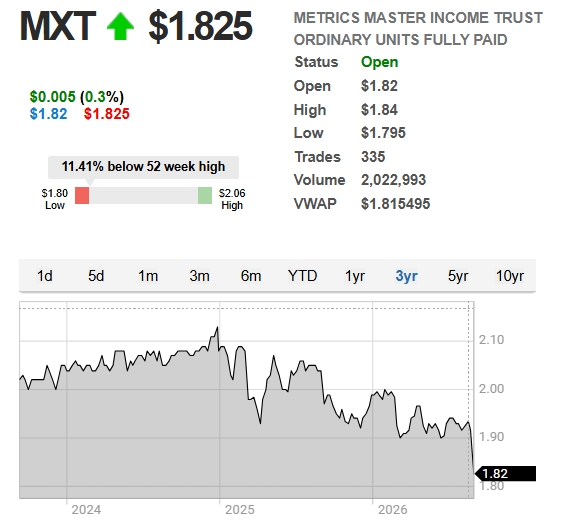
One thing is wrong. Either the value of Metrics portfolio is accurate and the share price is wrong. Or, the share price is telling us the valuation of the assets is not right.
Now, that is a bit dramatic. Likely the truth sits somewhere in between. But the divergence is either a warning or an opportunity.
Listed Investment Trusts and Listed Investment Companies can often trade at a discount or premium to their NTA.
In this environment of heightened scrutiny on Private Credit in general there are others that also trade at a discount, even when they have nothing to do with Bathla or the Australian Real-Estate development scene.
One example is the KKR Credit Income Fund, which trades on the ASX under the code KKC.
This fund combines both a portfolio of direct loans (principally in Europe) and traded credit in the form of high yield bonds (sub investment grade) bank loans and structured credit held within the KKR Opportunistic Credit Fund.
At present the stated NTA is $2.30 per share. However, recently the units briefly traded down as low as $1.95.
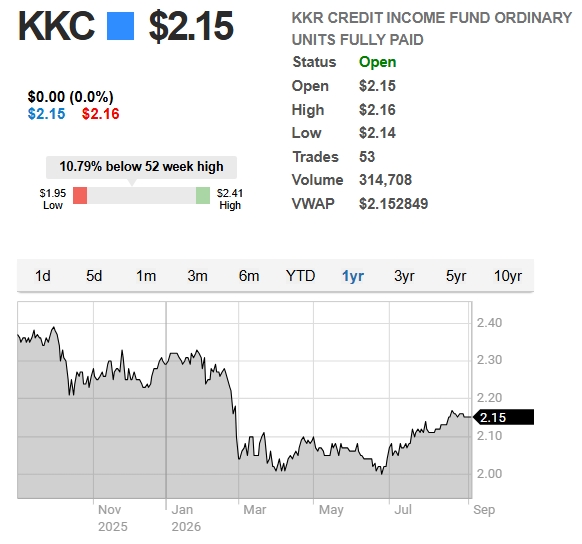
As can be seen above, the KKC had a big fall of around 15% from January to April as fears of contagion in the global private credit markets grew following the collapse of auto lender Tricolor Holdings and UK mortgage lender Market Financial Solutions. Now they are on the rise again as that concern abates.
Situations like this can create opportunities where listed assets provide a cheaper exposure than un-listed funds, even though they have greater day to day volatility.
Conclusions
We cannot dismiss the risks altogether. Bathla may be the canary in the coal mine. In 2007 Bear Stearns and then BNP Paribas froze their sub-prime mortgage and asset backed securities funds, which was a precursor to the 2008 GFC.
Being aware of the risks, allocating appropriate amounts of capital to each situation, proper diversification and being patient are all needed to navigate the waters we see ahead.
This article is general information only. It does not take into account the objectives, financial situation or needs of any person and does not constitute personal financial product advice. Fund exposures, terms and redemption arrangements can change; investors should consult current product disclosure statements and their own licensed adviser.